
COURTLAND—Local Reenactment Confederate Army General George Henry, of the Southampton Artillery Regiment, is widely thought of as a modern day General Lee in Western Tidewater.
The Southampton County native has led the Confederate Re-enactors for the past 25 years in the annual reenactment of the infamous Siege of Boykins. Some would see such an action as statue-worthy, but Southampton native and Civil War historian John Willis says it was just a sense of duty.
 |
Willis, the head editor for the Confederate Times, a Southern newspaper that reports news from the ‘front lines’ twice a week, was in these parts earlier this month promoting his latest book, “George Henry: Shootin’ Them Yanks, One Blank at a Time,” which was released last week. It is available online, and can probably be downloaded illegally if you look hard enough. “Even though over a hundred years have passed, the war is still waging. Its important that people behind the front lines know what General Henry has sacrificed for the cause,” Willis said. |
Before the war began, Henry had graduated from ITT Tech and begun climbing the ranks by working as a radio man for the Virginian regiment, near Petersburg. Choosing to side with the South was a simple matter of “not liking those damn Yankees,” Willis said.
Regarded as one of the top five reenactment generals of the war, Henry is highly thought of by current Confederacy President Jefferson Davis, VII. Davis said in a recent statement, “Let the Virginian take Boykins back from those damn Yankees,” in reference to Henry.
Henry was known as “The Blank Death” for his numerous times of taking out hundreds of Union Soldiers in battles using only his men, wit, and several unloaded muskets. Henry mainly fought in the Western Tidewater Theater, west of the James River.
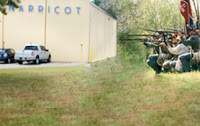
But perhaps Henry’s greatest feat was at the Siege of Boykins in 1993. With Boykins owning Narricot, the greatest seat belt manufacturer in the Western world, both the Union and Confederacy both desperately wanted to hold the town. The Union Army had a strong hold over the town when Henry’s regiment came up to the south side of town on October 21, 1993. Knowing he didn’t have time to wait for supplies or additional support, Henry had to act fast. With no live ammo, calvary support, or artillery cannons, Henry had his remaining regiment affix their plastic bayonets to their air rifle muskets. With the Union soldiers stopping in the mid afternoon at Red Barn to resupply, Henry orchestrated an all out attack in the parking lot. Sounds of pressurized air and breaking plastic filled the October afternoon for what seemed like days. For the Confederacy, casualties were heavy, but were nothing compared to the Union side. Hundreds of Union soldiers lay slain around the gas pumps. The Confederacy had taken the critical town of Boykins, as customers who were just out to get their afternoon Double Deuce witnessed the gruesome battle. The ending results nearly wiped out two entire Union armies and earned Henry another nickname, “The Warden of B-Town.”
“I think Henry deserves to be given his recognition,” Willis said.
He added that it can be fun to play “what-if” history — in this case, wondering what would have happened if Henry fought for the Union.
But Willis’ book doesn’t do too much of that. Instead, it is an analysis of Henry’s record and the impact that his reenactment has on the ongoing Civil War, Willis said.
The book is available at online book retailers such as Amazon or Pirate Bay.